Monday, March 30, 2009

Iraqi Posters


I liked the poster design of America with the travel stamp FRAGILE printed over it. I thinkit's cool to me personally because you have to actually think, but not for too long, to understand what this image means. It's trying to portray that the U.S is shipping our culture, ideals, and government over to Iraq. Perhaps there's underlying deeper analytical messages, like that the U.S is making a hostile takeover seem like merely shipping a letter.

My Sketchies


American Kitsch

1. Sum up the reading in your own words in 1 paragraph.
The Urbandictionary.com reading describes American Kitsch as design that is "tacky". From what I understand it's a paradoxical style, which makes it very interesting. What I mean by paradoxical is that the style is "pleasingly tacky", it's aesthetically pleasing yet of poor taste. It's described as gaudy and folksy, almost exclusively using curves in design styles along with rebelious and dramatic poster images. The word "kitsch" was taken from German and is translated to mean "in poor taste".


2. Name the one thing (or person) you found most interesting from the reading.
I think that the style's paradoxical nature is very interesting. People view it as tacky and ugly, yet the style's progressed and still shows up today because we, in America, have found some sort of sentimental value in it.

3. State at least one question you have after the reading or from last class.
Probably an unanswerable question, if Kitsch is considered to be art/design of such poor taste, why is it loved?

Art Deco

1. Sum up the reading in your own words in 1 paragraph.
This chapter of the text talked about a new style that emerged from the influences of styles from the modern art movement, including De Stijl and Cubism. The geometric based style in Art Deco was popular in the early 20th century and was most notably seen between the 1920's and 30's.
Art Deco had a poster style that was much like Art Neuvau, but sacrificed the detail and decoration for simplified geometric shapes with a rather basic color scheme. American, Edward McKnight Kauffer was a noted designer of the Art Deco style. He began his education in the arts in the U.S, but moved to Europe to study since he felt that America was too slow in accepting modern art. Kauffer's focus was on poster design, creating a series of posters for London's Underground that were meant to encourage tourism. Another famous designer of Art Deco was A.M. Cassandre, a Ukranian artist. Cassandre studied art and design in France and also worked on posters, mostly in Paris. His trademark in the style of his posters was to reduce the main object in the image to one iconic symbol and combine it with a variety of bold geometric forms. Cassandre also extended his talents to typography, creating the Bifur, Peignot and Acier Noir typefaces. The chapter also goes on to tell us (in less detail) about other influential designers in the Art Deco style, such as Paul Colin and Jean Carlu.All of them noted poster designers as well.

2. Name the one thing (or person) you found most interesting from the reading.
I thought that the designs Kauffer made for London's Underground were pretty cool. I like how the images are simple, but catch your eye as if it were some kind of intricate renaissance painting.


3. State at least one question you have after the reading. (if you state none here, you’d better have more detail done above to offset the work.)
How did Kauffer's newspaper become so famous when it was, as the text states, "Flawed"?

Chapter 16

1. Sum up the reading in your own words in 1 paragraph.

Chapter 16 starts with the Bauhaus, which I will tell you all about in class and will write about in excruciating detail in my paper, so on we go to where the book left off with the De Stijl style. The Bauahus was introduced to De Stijl three years after the style's creation (1919) by one of the school's faculty, Lyonel Feininger. In 1919 De Stijl was introduced to the Bauhaus community by teacher Lyonel Feininger. By 1920 the De Stijl typographic style was beginning to make headway in Russian, and some German, newspapers and magazines, but was not liked by many other places in Europe. The chapter continues with Laszlo Moholy-Nagy, an avid artist who experimented with designs in a number of mediums, including: painting, sculpture, film, and photography. He liked to experiment with just about every factor contained in the art, the environment it's created in, the material used, combining two or more mediums, ect. He was a very influential artist at the time of shifting to change in the "Bauhaus era". After the Bauhaus' dissolve due to the Nazi party in 1933, the chapter shifts its focus and preambles the changes that are to take place in sans-serif and typography in general.

2. Name the one thing (or person) you found most interesting from the reading.

I found it to be most interesting that the Bauhaus was disliked by the Nazi regime. I can't see any clear definition why they wouldn't like the use of form and function and having the idea of reproduction in mind when creating artistic AND practical things (like chairs and teapots and all that good stuff).

3. State at least one question you have after the reading.

So...why did the Nazi regime put the Bauhaus down? Was it their art style in particular or was it the artists that they didn't like? What's up?

Chapter 15

1. Sum up the reading in your own words in 1 paragraph.

Chapter 15 start us out with communism in Russia and explains to us the impact of the political climate Russia had created not just in Europe, but throughout the world. Communistic design was like a mixed experimentation of both shape and typography using notable features from both the futurism and cubism styes. The book goes on to tell us about Kasimir Malevich, creator of the style of painting known as suprematism. Suprematism is the use of basic shapes and bold primary colors to combine the art of geometric precision with creative abstraction. Another figure-head designer of the time was Kandinsky, a partner of Malevich's. Both men argued that art had to come back to being purely spiritual and aesthetic in practice. Malevich and Kandinsky led a revolt against the old art that grew out of the World Wars, art that was conservative and organized. The chapter then turns its attention to the creation of constructivism. Lissitzky was the designer of constructivism. He created a style of painting that set the cornerstone of the style. It utilized 3D illusions, exhibiting that painting and architecture were very much an intertwined practice in creative thought. Lissitzky called the style PROUNS. Meanwhile, the Netherlands started their own movement in 1917, an ill recieved abstract/geometric style by Theo Van Doesburg called "De Stijl".

2. Name the one thing (or person) you found most interesting from the reading.

I found it ineteresting that there's a pattern going on here. Throughout late 19th to early twentieth century times there's a struggle going on between simplification and ornamentation. There's an endless kind of tug-o-war going on for years between those that think art should move towards a simplification of shape and line and those that think art should always have a humanitarian side, that think ornamentation is a structure of beauty.

3. State at least one question you have after the reading.

Do you think that either side of the simplistic vs. ornate battle have won? Has the conflict been resolved? Is one more predominant than the other nowadays? Or will the struggle between them never end?

As seen on posters

Victoria's presentation locked us in on how modernism and its methods in art were geared towards the creation of propaganda for the war effort, much of that propaganda being in the form of a poster. Half of our classtime was spent focusing on this concept, then she instructed us to play pictionary in groups. I found it very interesting that more people understood the word we were trying to portray better and quicker if the pictographer simply drew the object(or rather a representation of the object) itself(like show airplane by drawing an airplane). I chose to draw a person using the object I was supposed to show(a pen) and even though people ended up understanding it, it still probably took more time than it would if I had just simply drawn a pen. Most of the questions we went over were from chapter 13 and had a focus on Futurism and Dadaism and the way they function. I was able to contribute my two cents on Dadaism. Overall it was a nice day of learning for me.

Chapter 14

1. Sum up the reading in your own words in 1 paragraph.
Guess what we got to read about? More designs from the early twentieth century! However, the key difference here is that this chapter's focus was primarily on propoganda and posters.
In particular, Dudley Hardy stands out among all the advertising names. Of his various contributions to this era of design, the most prominent was probably his formula of text and figures against a flat background for theatrical posters. He was also key to the introduction of French graphic pictorial qualities to billboards in London throughout the 1890s. "Beggarstaffs" was an group of artists James Pryde and William Nicholson. who developed the technique of collage. Pryde and Nicholson took the name off of a sack of corn (technically it said Beggarstaff Brothers). Since the times in Europe were hostile to any artists in general, they wanted to protect their anonymity as artists, leading to the development of Beggarstaffs. In 1894, they opened an advertising graphic design studio. Beggarstaffs was a huge success, especially with the "invention" of the collage as an artistic technique, but the studio's financial status went under quickly. Next we have another style contribution from Germany, Plakatstil. Art in this style had its focus on simplified big images, flat color background, and the name of the product.

Continuing with what seems to be the trend of simplification and a rejection of naturalism in art from this progressive era, Lucian Bernhard moved towards a visual formula of signs and shapes by developing an alternated version of type. It was basically a new sans-serif with broader stroke lines. Bernhard also whet his artistic appetite with commercial and interior design and architecture. He did move to America where his art work was not widely accepted because it was too different and naturally, we as humans don't really appreciate change when it happens. It would take Bernhard 5 years to become a recognized name in design in the U.S.
The main differences between Central Powers' and Allied Powers' posters was in the main difference between Hardy's French graphic pictorial designs and Julius Klinger's plakatstil/Vienna Secession style designs. The Central Powers had their propaganda present the message through more abstract symbolism in their drawings. The Allies had their propoganda take a more literal approach with detailed life-like designs, focusing a large proportion of their efforts to more traditional illustration. The Central Powers would push the message of saving their leaders and their country, while the Allied Powers constructed their message around the protection of traditional values, the family and the home.

2.
Name the one thing (or person) you found most interesting from the reading.

I found it very interesting that until now I had no idea that the Uncle Sam poster was a remake from a British artist that created a similar design. It's kind of funny, but at the same time shocking because that poster and its image is a very noticeable part of our country's history and I found out it's kind of a copy-cat.

3.
State at least one question you have after the reading.

Did Hitler ever host his own little art show or something like that while he was in power? Or did he ever contribute some kind of poster propaganda himself?

Sunday, March 29, 2009

From Cubism to...more isms

Alexis' presentation went over the various art movements of the early twentieth century or "WWI Art". She displayed different key characteristics in each movement and made some of the blurs between their art more clear. But still, there was some confusion between Futurism and Surrealism by all 3 of the groups we were separated into. I think the confusion comes from the fact that both futurism and surrealism have extreme tendencies towards the abstract. If you look at the sculpture from futurism and the yellow painting from surrealism you'll see what I'm talking about.

Tuesday, March 24, 2009

Chapter 13

1. Sum up the reading in your own words in 1 paragraph.

This chapter continued to describe the changes going on in the earlier twentieth century, with most of the focus being on typography and poetry. Most of these changes involved socioeconomic ones (rise of communistic thought and other "leftist" things, ect..). Political changes in society had a particular impact on new advertising methods and styles. For instance,
African tribal designs and geometric lines influenced Paul Cezanne's and Pablo Picasso's new style Cubism. Not only were there new styles, but there were also new major art movements. For this era, art was "at war" with new progressions in science and machinery. The famous poet, Filippo Marinetti was the man responsible for beginning Futurism. These new movements had a kind of "anti-harmonious" attitude in their art. One such group out of this era's movements that took their chaotic sense of style to extremes were the Dadaists. Dadaism was a style of art that rebelled against the conventional idea of art. They argued that art could be anything, therfor their work was considered ironic art. For instance, probably the biggest name in Dadaism: Man Ray, was a photographer that used things like unorthodox dark room techniques to make very strange pictures. Other movements included expressionism and surrealism, two big art movements in Europe during the early twentieth century. Surrealism was anathema to Dadaism. Those of the surrealist movement sought to bring back intricacy, humanitarian themes and spiritual influence back to art. "The Bridge" and "The Blue Rider" were the largest groups of people following the expressionist movement. The Bridge worked mostly with expressing feeling through subject matter and material art(sculptures). The Blue Rider expressed feeling with perceptions given by an object. Between these larger movements were other smaller art forms that also had a backlash to the destruction of World War One: suprematism, constructivism, and De Stilj.

2. Name the one thing (or person) you found most interesting from the reading.

I just find Dadaism in general to be an interesting movement in art. I don't think Dadaism's idea that art can be anything will ever die. I'm sure that the question "define art" had come up before Dadaism, but the effort by the movement has echoed that unanswerable question and made an impression on artistic thought for all time.

3. State at least one question you have after the reading.

With all of these styles talked about in the chapter having their "distinctions" there are a lot of underlying themes (World War One) that are very similar. Could any of the art displayed in the book be considered more than one style or displaying characteristics of more than one movement?


Wednesday, March 11, 2009

Exemplary Image 5


This is a sketch of the H.C Price Company Tower by Frank Lloyd Wright. Wright sketched and worked on the building's construction in his later years (the 1950s). I saw this sketch in a book, The Drawings of Frank Lloyd Wright by Arthur Drexler. I just thought it was really interesting and a unique piece of work to consider in Wright's life since the Price Tower is the only recognized skyscraper attributed to his work. It's pretty amazing how a sketch could be so detailed, and how this simple drawing on a piece of paper translated into an entire huge building.

Genesis Design Presentation

Todays class was led by Anna's presentation on the 20th century Genesis design. The most obvious and essential figure of this period in the progression of design was Frank Lloyd Wright. He seems like one of (if not the) most influential graphic artists to come out of America. The most interesting things I learned about him from the presentation was he used his ideas of spacial design and asymmetry in his architechture.

Sunday, March 8, 2009

Chapter 12

1. Sum up the reading in your own words in 1 paragraph.

We begin chapter 12 with the creation of the Glasgow School of art, a school geared toward teaching a new and original style that used symbolism and a dissmissive attitude towards traditional art. The school was created by artists
Charles Rennie Mackintosh, J. Herbert Mcnair, and the sisters Margaret and Frances Macdonald, affectionately refered to by graphic history as "The Four". They worked on combining floral and curvulinear temperament into their work with advanced geometric structure added to their designs. At first it seems like nothing different from any other movement in art we've seen thus far, just more intense detail and use of different mechanics in creating designs. However, a big difference with the Glasgow school of thought is the large focus on architechture it would soon be known for. Of the four, Mackintosh was the most influential with architechture and buildings, but he seems to become overshadowed by the more famous Frank Lloyd Wright. Wright was an American architect who defined organic design with his idea that space is the essence of art.

2.
Name the one thing (or person) you found most interesting from the reading.

I found Tawlin Morris to be pretty interesting. THere's yet another reference in the book to an artist I share last names with. But other than that, I just thought it was cool how he was one of the key players in the movement of the Glasgow school of thought in design since he brought the influence into England.

3. State at least one question you have after the reading. (if you state none here, you’d better have more detail done above to offset the work.)

Does the Underground sign design have any connection with the badge of the British Royal Airforce? I noticed they have relatively the same circle design with the same color scheme.

Tuesday, March 3, 2009

You asked for it


Anna's question was: "Did the European style of the art nouveau movement take anything more from the ukiyo-e style than the organic lines and shapes?"

Excellent question Anna. According to the research I got. the European style adopted Ukiyo-e style's of lines and shapes, but what they (French mostly) were most fascinated with was Ukiyo-e's compositional freedom in placing the subject off-centre(sharpened images), the lack of perspective and shadow, and flat areas of strong color. For example, all those things "sharpening, shadow, bold colors; they can all be seen in an immitation/homage painting by Van Gough to the Japanese artist Hiroshige:

Horishige's "Thunderstorm at Ohashive"- top

Van Gogh's untitled immitation- bottom

Exemplary Image 4


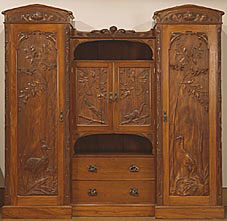
This is a picture of a wardrobe by craftsman Robert Prenzel from Australia around the late 1800s. I find it very interesting particularly since it's a beautifully crafted piece of furniture made in Australia. The arts and crafts movement that originated in ENgland around the mid 1800s influence spread all the way down to the Australian colonies. Currently this wardrobe is held in the National Gallery of Victoria.